A round face does not need a corrective haircut. Compare a defined bob, a longer outline, or a cropped style by where the hair ends and how much daily styling you want. Choose a line you enjoy rather than trying to change your face.
Use this guide to narrow the choice to two cuts and write down questions for a stylist. A shape description cannot tell you your hair’s dry length, density, natural fall, or how much time you want to spend styling it; those inputs come from your own hair and routine.
Describe the Contour Without Setting a Correction Goal
“Round” can be a useful shorthand when the visible face length and width seem fairly similar and the lower contour looks curved. It is a description of one view, not a fixed classification. If your photo leaves the outline unclear, describe your face proportions before using a shape name.
Decide what you want to see in the haircut itself: a crisp edge, a softer outline with volume, or an open ear and neck. You can choose any of these without setting a goal to make your face appear narrower.
Use What You Can See
If the jaw line looks angular rather than curved, keep that observation. You may later compare a square-face guide as well; there is no need to force one winning label. Camera angle, expression, and hair near the face can change what you see in a photo.
A Defined Bob or a Longer Outline?
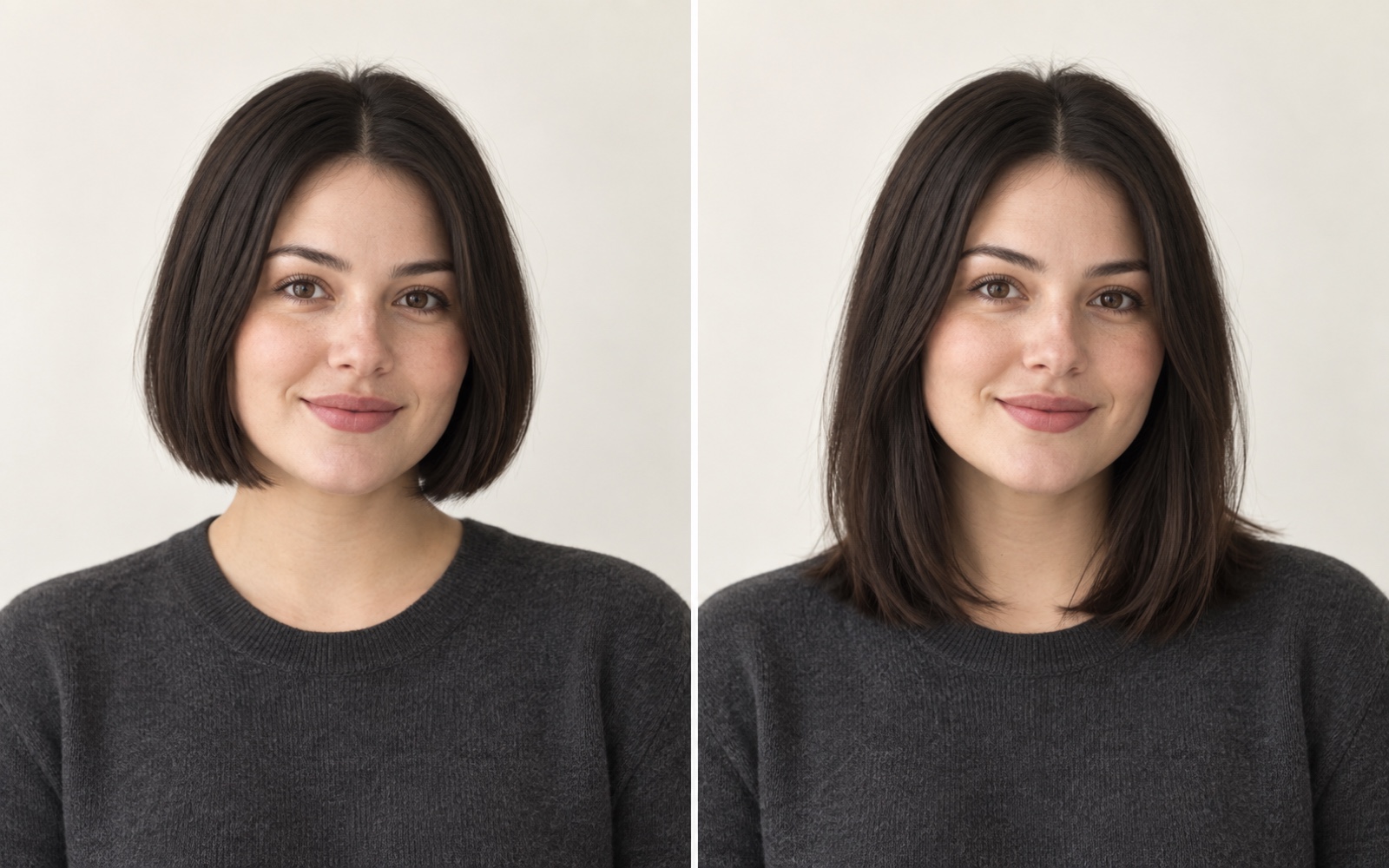
A jaw-length bob puts a strong end line beside the jaw; a lob (long bob) carries that line toward the collarbone. If you want layers, compare where the shortest layer ends as well as the full perimeter. Check how much of your ears and neck each option leaves visible, whether you want to tuck the front pieces away, and whether you need enough length to gather your hair. Neither outline is required by a round-face label. For a wider set of lengths, compare haircut options in the general guide. A professional discussion of face shape and hair texture also includes bobs and lobs as examples; its examples are ideas to inspect, not personal prescriptions.
| Option | Line to compare | Ask your stylist |
|---|---|---|
| Jaw-length bob | Ends near the jaw; ears and neck may show more clearly | Where will the edge fall when my hair is dry? Can I tuck the front pieces behind my ears? |
| Collarbone lob | Ends closer to the collarbone; more length remains around the neck | Can I gather the length I need? Where will the line sit after my usual drying routine? |
Keep the Face Constant in the Comparison
The illustration keeps the face, pose, and lighting constant while changing the hair’s length and perimeter (its outer edge). It helps you compare two lines, but it cannot predict how either cut will fall on your own hair.
Short Cuts and Parting Choices
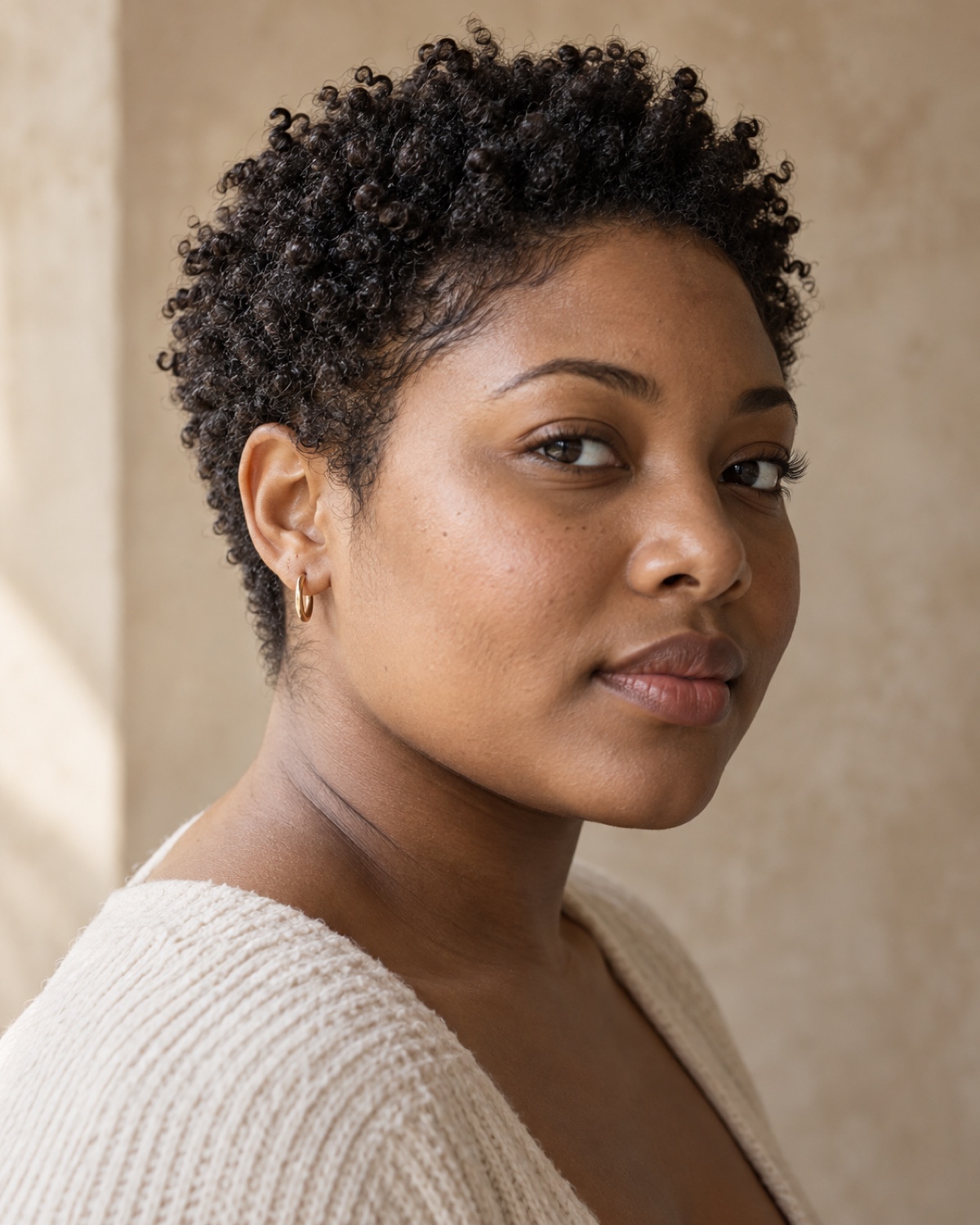
A cropped cut can leave the ears and nape visible. A short cut with longer pieces at the front can keep more hair beside the cheeks while still opening the neck. Compare the actual endpoints and the silhouette you like; short hair is an option, not a rule or an exception for round proportions.
A center part places the division along the middle; a side part moves that line off center. Try both with the way your hair naturally falls. There is no need to rule out a center part because of a face-shape label.
Match the Reference to Your Texture
Bring a short-cut reference with a texture reasonably close to yours. Straight and coily hair can make different dry outlines and may ask for different styling actions. The portrait below shows one cropped, coily option with the ear and nape visible, not a result promised for another person’s hair.
Ask a stylist to compare a bob and a lob in your hair’s ordinary dry state. A face-shape label says nothing about hair density or texture. If flyaway strands are part of how your hair normally looks, include them in the reference discussion; a haircut alone cannot promise to remove them.
Choose Bangs by Their Endpoint
An open forehead keeps the front hairline visible. Long, parted bangs cover some of it while leaving a gap; a shorter, more continuous fringe creates a stronger line across it. For each option, ask where the fringe will end when dry and what you would do with it on an ordinary morning.
Check how the chosen fringe meets your bob or short cut at the sides. A dedicated bangs-for-face-shape guide will cover fringe styles in detail when its route is ready; this page focuses on how the front edge fits the two cuts you are comparing.
Check Glasses and Ear Tucking
If you wear glasses, check whether front pieces fall across the frames. Try tucking those pieces behind your ears and ask whether the proposed dry length will still allow it. Compare glasses frames and fit if frames are also part of your decision.
Take Two Specific Requests to the Salon
Record the outline you want, your current dry length, the daily actions you are willing to do, and two references showing different options. Tell the stylist which endpoints matter. A reference gives a shared vocabulary; it does not guarantee the same result on different hair.
| If you want to… | Ask about length | Ask about upkeep |
|---|---|---|
| Keep a way to gather your hair | “What is the shortest dry length that still lets me tie it back?” | “What will the front pieces need after my usual wash and dry?” |
| Open the neck | “Where will the short perimeter sit when dry?” | “How could I wear it as that edge grows out?” |
Ask About the First Wash
Ask the stylist to walk you through what to do after your first ordinary wash and dry. Name the tools you use or avoid, and ask how to keep the chosen outline with that routine. A specific plan is more useful than a promised number of styling minutes.
Questions About Choosing This Haircut
Can I wear a chin-length bob with a round face?
Yes. Compare its line at your own dry length and the styling it asks of you, then decide whether you like that look.
Do I have to add height at the crown?
No. Crown volume is one possible silhouette choice, not a requirement for round proportions.
Compare your two options: use the haircut comparison guide to check their endpoints and upkeep, then take both references to your stylist.